Weekly Newsletters, Fall 2008-Spring 2009

Showing posts with label international issues. Show all posts

Friday, November 14, 2008

CSUN student released on bail in Iran

Esha Momeni was arrested last month while working on a master's thesis about women's rights. She still faces charges of 'acting against national security,' which could bring a lengthy prison term.
By Ramin Mostaghim and Borzou Daragahi
November 11, 2008
Reporting from Tehran and Beirut -- A Cal State Northridge graduate student who was arrested in Iran last month was released on $200,000 bail Monday, her father said.

Esha Momeni, 28, a dual U.S. and Iranian citizen who was visiting Iran to research a master's thesis, may not leave the country and must still stand before a political tribunal to face charges of "acting against national security" and "propagating against the system," said Reza Momeni, her father.

[Image here]

Both are serious charges that can carry lengthy prison sentences.

In a brief telephone interview, Momeni said his daughter had lost about 15 pounds but otherwise appeared to be in good health. He said he had to put up the deed to his family's Tehran apartment as collateral to win his Los Angeles-born daughter's release.

"I hope she will go back to L.A. soon," he said. "But for now, the authorities told us she is forbidden to go out. Tomorrow, we will be in court, and they will tell us what the next step will be."

Esha Momeni moved to Iran with her family at a young age but returned to the United States to study after she divorced in 2005. She traveled to Iran about 10 weeks ago to videotape interviews with women's rights activists as part of a master's project. She was focusing on members of the One Million Signatures Campaign for Equality, a loosely organized group that advocates better rights for Iranian women.

She was arrested and locked up in a political ward inside Tehran's Evin prison Oct. 15 after what at first appeared to be a routine traffic stop. Instead of issuing a ticket, however, police escorted her to her parents' home, where she was staying, searched the flat and seized her computer before taking her away.

News of the arrest spread abroad. Her classmates at Cal State Northridge launched a website, for-esha.blogspot.com, calling for her release. Italy's ambassador to Iran last week lodged a formal complaint about her detention, Italy's official ANSA news agency reported.

On Friday, her father was quoted by Iran's official Islamic Republic News Agency as saying he disapproved of his daughter's activities.

"I had no knowledge about the illegal activities of my daughter," he said. "But now I have realized that her work was illegal."

He also denied reports that he had been barred from seeing her, saying that he and his wife "did not want to visit her" in prison "because of our anger in connection to her activities."

Mostaghim is a special correspondent. Daragahi is a Times staff writer.

daragahi@latimes.com

An intellectual makeover for Iranian women

An intellectual makeover for Iranian women

Nazanin Gohari
Newsha Tavakolian / For The Times
Nazanin Gohari has turned her living room into a library for women, with secondhand books filling up makeshift bookshelves.
In an impoverished Tehran district, a hairdresser-turned-activist helps girls and women help themselves through books, health workshops and civic action.
By Borzou Daragahi
November 14, 2008
Reporting from Tehran -- In her eyes, they are all daughters and sisters. The waifish 18-year-old, already married and a mother, but with a hunger to learn. The pair of shy high school students, nervous at first, but soon browsing eagerly through the bookshelves. The matronly homemaker, unsure and uneducated, but discovering the world beyond the slums of southern Tehran by reading Feodor Dostoevski and Jean-Paul Sartre.

For the women in her neighborhood, Nazanin Gohari has become a savior of minds.

[Image here]

A few years back, the part-time hairdresser-turned-community activist transformed her shabby apartment into a library for women, collecting secondhand books to fill the makeshift shelves in her living room.

First she stocked them with trashy novels, poetry and how-to and self-help titles. But the demand for cookbooks and sewing patterns eventually gave way to requests for college-preparation books and literature. The girls leafing through illustrated children's books bloomed into strong-willed women eager to pursue higher education.

Gohari remembers one girl, a 17-year-old named Sedigheh, who came to her crying, distraught that her parents couldn't afford the study materials for college entrance exams. Scoring high would place the bright teenager on the fast track to a potentially glorious future, maybe even including medical school. Not taking the test would mean a life more ordinary, perhaps married to a man twice her age, tending to babies and home.

For Gohari, helping the teen became a mission, one of many. She scoured the city for the study books, relatively cheap by Western standards but a fortune for Iran's poor.

"She was ashamed because she couldn't afford the books," Gohari said.

The older woman put her hand out to the girl. "I said, 'Study here.' " And then Gohari handed her the books.

A plump, bespectacled woman now in her late 50s, Gohari delights in the women in her impoverished district, recounting the details of their triumphs and ordeals. She sprinkles her sentences with folksy praises of God as she speaks excitedly about her adventures as a grass-roots activist, filling a social and even political vacuum created by Iran's rapid transition from a largely rural nation where people tended to neighbors' needs to today's impersonal urban society where most fend for themselves.

Obscured from public view, Iran's women have quietly navigated restrictions of politics, religion and tradition over the last three decades to bolster their status and advance into positions of power.

Although the conservative clerics who took over the country after the 1979 ouster of Shah Mohammed Reza Pahlavi hoped to ossify women's traditional roles, they set in place dynamics that liberated them. As the clerics launched literacy drives and built hundreds of colleges around the country, Iran's literacy rate rose from less than 50% in the 1970s to as high as 85% today.

Instead of creating a powerful new Islamic generation, they pushed the country into the modern age, raising the ambitions and savvy of young Iranians, half of them women, who began to question society's rules and strictures.

"It's one of the ironies of the revolution that women's sense of self has become much stronger," said Pardis Mahdavi, an Iranian American anthropologist who teaches at Pomona College and wrote the 2008 book "Passionate Uprisings," about the evolution of sex and gender in Iran. "The revolution has given birth to a stronger women's movement."

Gohari, a mother of two and the wife of a civil servant, began embracing community activism in the early 1990s, shortly after the Iran-Iraq war and the death of Ayatollah Ruhollah Khomeini. Wartime restrictions loosened and the revolutionary leader's charismatic spell was broken. The country began to focus on practical matters such as rebuilding a ravaged infrastructure and promoting better health. A social worker dispatched to Gohari's neighborhood, the ancient district of Rey, charmed her into attending a breast cancer awareness workshop.

She didn't want to go at first. But from the beginning of the initial session, on breast self-examinations, it was a revelation. One of her best friends had died of breast cancer. "It was eye-opening," she said. "Those 10 minutes changed my life."

The reluctant student became a cheerleader for women's health, encouraging her neighbors, many of them poor recent arrivals from the countryside, to come to workshops on prenatal care, child development, breast cancer awareness, nutrition, sex education and mental health.

"I would offer women discounts on hairdos if they would come to the courses," Gohari said.

She began organizing the women to demand better municipal services, better-lighted streets clear of drug addicts and criminals, and parks where mothers could take their children without fear of being accosted by panhandlers or stumbling over used needles.

Gohari was elected head of a women's council that she and her neighbors created. They began demanding meetings with municipal leaders.

One top official for the Ministry of Electricity resisted. His excuse: He didn't like dealing with women.

[continue reading here...]

Sunday, October 26, 2008

A Woman Leads Muslim Prayer in Britain For the First Time
By Fatemeh Fakhraie
October 22, 2008

The landmark event depicts a religion in transition, but what of the criticisms that it's just a publicity stunt?

Last Friday, Dr. Amina Wadud led a mixed-gender congregation of 15 people in prayer in the U.K. This is the first time that any Muslim woman has done so in Britain, and the second time Dr. Wadud has led a mixed congregational prayer (she made history by leading a congregation in New York City in 2005).

Plenty of less-than-enthusiastic Muslims lined up outside to protest Dr. Wadud because they feel Islamic law does not permit women to lead prayer. Several prominent Muslims in Britain, including the Vice President of the Muslim Association of Britain, issued statements opposing the sermon. On the blogosphere, there have been mixed reactions. There are people who are down with the idea, people who aren't aren’t, and some in between.

Personally, I'm in the camp that finds Dr. Wadud and her work to be awesome, including her leading prayer. My only major qualm is with the media presence: the cameras make the event look like a publicity stunt (which is one of the accusations made by those who disagree with Dr. Wadud) which would lessen its value. I can understand the desire for transparency and wanting to share this occasion with others around the world. But frankly, it doesn’t good when cameras outnumber actual worshippers.

Still, the critical point here is that Dr. Wadud’s work illustrates that Islam is not a stagnant religion and that Muslims aren’t religiously-programmed robots. For many people, Islam is not rigid or immutable, but changes as we and our societies evolve. This is an example of what can happen when a fresh pair of eyes delves into Islamic theology and law. Dr. Wadud’s work is not presently accepted by the majority of Muslims, but it is important work nonetheless.

Bio
Fatemeh Fakhraie is an Iranian-American Muslim woman who writes articles about race, religion, and feminism in different outlets, and speaks publicly about issues that Muslim women face from an Islamic feminist viewpoint. She founded and currently serves as editor of Muslimah Media Watch, a website that critiques media images of Muslim women.
An Open Letter to White Non-Muslim Western Feminists
by Fatemeh, muslimnista.org

We need to talk.

Having the economic privilege to spend a few summers in Cairo or to study abroad in Dubai does not give you the authority to speak about Middle Eastern culture.

Dating a Saudi guy does not give you the authority to speak about Islam. Or about Muslim men.

Knowing some Muslim women through work or as friends does not give you the authority to speak for them or the rest of Muslim women.

There are those of us who suffer. But don’t speak of us as victims if we are not dead. Don’t deny the agency with which we become survivors and active shapers of our lives. Don’t ignore the fighting we do for ourselves.

We can—and do—speak for ourselves. So stop speaking for us.

I notice a lot of condescension and arrogance when you talk to us or about us. Let me be clear: you do not know more about us than we know about ourselves, our religion, our cultures, our families, or the forces that shape our lives. You do not know what’s best for us more than we do.

So please check yourselves.

Being an ally does not mean speaking for us, making choices for us, or figuring out what’s best for us. It means supporting and defending the choices we make and the voices we use.

If we want help, and ask for it, then do only what you’re asked. Don’t invent new ways to characterize us as oppressed or agitate for the solving of problems that aren’t pressingly important. Case in point: if we want better divorce laws in a particular country, don’t agitate for the abolishing of mandatory clothing policies.

If you can’t do that, then don’t bother. It’s better to just stay out of our way. Passing judgment on and mischaracterizing our choices, our religion, or ways of life does us more harm than good; with friends like that, who needs enemies?

Sincerely,

An Islamic feminist who has met one-too-many white non-Muslim feminists that assume that they know better

Wednesday, October 22, 2008

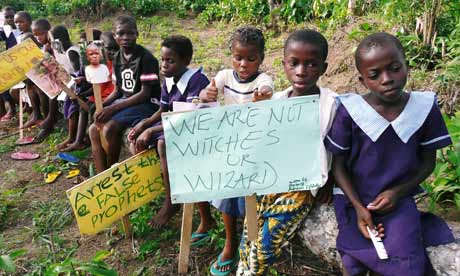
New Documentary: "Saving Africa's Witch Children"

Channel 4's Dispatches to investigate Nigerian 'witch children'

From The Guardian UK: Oscar-nominated actor Sophie Okonedo is to narrate a hard-hitting Dispatches programme for Channel 4 (UK) about children in Nigeria who are tortured for being witches.

The new programme... will look at the phenomenon of children who are blamed for catastrophes, death and famine and branded witches in some of the poorest parts of Nigeria.

Saving Africa's Witch Children follows Briton Gary Foxcroft, who has devoted his life to raising money to help the children and who works with Nigerian Sam Itauma, who runs a shelter for children accused of witchcraft.

The documentary will feature shocking stories of torture inflicted on children, including a 13-year-old who was tied up with chicken wire and starved and beaten for two weeks, and a 14-year-old girl who was burned with acid before her mother attempted to bury her alive.

Read the full article here.

Afghan gets 20 years for women’s rights talk

Afghan gets 20 years for women’s rights talk
Death sentence quashed, but student is jailed over Islam questions in class

KABUL, Afghanistan - An Afghan appeals court overturned a death sentence Tuesday for a journalism student accused of blasphemy for asking questions in class about women's rights under Islam. But the judges still sentenced him to 20 years in prison.

Read the story here.

Wednesday, March 19, 2008

"Feminist Theologies: Heritage and Future" a Summer Forum

"Feminist Theologies: Heritage and Future" a Summer Forum

The Women's Alliance for Theology, Ethics and Ritual (WATER) and Feminist Studies in Religion, Inc. (FSR) are pleased to invite graduate students and junior faculty to apply for the first Summer Forum on Feminist Theologies in Washington, DC, June 15-20, 2008. This inaugural year will focus on "Making the Connections: Claiming Our Past—Envisioning Our Future Together." This residential program provides the space and opportunity to work with colleagues across generations, religions, racial/ethnic, and disciplinary lines creating new knowledge and deepening feminist scholarly collaboration. Distinguished scholars in the field, including Katie Geneva Cannon, Mary E. Hunt, Judith Plaskow, Kwok Pui-lan, Elisabeth Schüssler Fiorenza, and Deborah Whitehead have agreed to provide leadership for the entire week of lively discussions and creative debate in a communal atmosphere. The application deadline is April 1, 2008.

For more information, including the application form, please visit:
http://www.his.com/~mhunt/

Thursday, November 29, 2007

Immigration Film Series in December

CSULB Campus Progressives Collective
Presents
Immigration Film Series

in the Multicultural Center

Films include:
Wetback: The Undocumented Documentary
Milton and Nayo embark on the riskful journey North, leaving Nicaragua and their families. Their disadvantage is not having the legal documentation to travel. With much sacrafice, they go in search of the “American Dream.”
December 4th, Tuesday
@ 7 p.m.


A Day Without a Mexican
This satire addresses questions such as: If illegal immigrants are such a problem in our country, what would happen if they all disappeared one day? Furthermore, what if all Latinos were to disappear? How would it affect our economy and personal lives?
December 11th, Tuesday
@ 7 p.m.


Farmingville
In the Long Island suburb of Farmingville, hate-based attempted murder of two day laborers made headlines. This documentary blends the stories of day laborers and town residents, revealing how our national policies has created violence, racism, and fear.
December 12th, Wednesday
@ 3 p.m.


For more information, contact: progressives-discussion@lists.riseup.net

Thursday, November 1, 2007

Valerie Plame Wilson at the Carpenter Center


Co-sponsored with the Carpenter Performing Arts Center, Office of the President, the Office of the Provost and Senior Vice President for Academic Affairs, the Division of Student Services, the Division of Administration and Finance, the Division of University Relations and Development, the President's Commission on the Status of Women, Student Life and Development, Associated Students, Inc., the Department of Political Science, and the Women's Resource Center

Who: Valerie Plame Wilson
What: Lecture

When: Monday, November 5, 2007 @ 7:00pm
Where: CSULB Carpenter Center

Ambassador Joseph Wilson and his wife, Valerie Plame Wilson, have served our country for over a combined 43 years. Valerie Plame joined the Central Intelligence Agency at the age of 22, and it has been widely reported that she worked undercover on several overseas assignments in areas related to counterterrorism and on counter-proliferation of weapons of mass destruction.

In July 2003, Ambassador Wilson spoke out against the Bush Administration’s false claim that Iraq had sought nuclear material in Africa, which had been a primary justification for going to war with Iraq . To punish and discredit Wilson and intimidate others who might come forward, senior Bush administration officials leaked to reporters the name of Wilson’s wife, Valerie Plame Wilson, and her classified CIA status – destroying her career and jeopardizing national security.

Following the leak, the CIA requested that the Justice Department conduct an investigation into whether the White House violated federal laws by revealing the identity of one of its undercover employees in retaliation against Ambassador Wilson. The Justice Department responded with the appointment of a special counsel, Patrick Fitzgerald. Evidence collected by Mr. Fitzgerald has shown that at least two Bush administration officials, Karl Rove and Lewis "Scooter" Libby, Jr., discussed Mrs. Wilson’s employment at the CIA with reporters. Last October, a grand jury indicted Mr. Libby, former Chief of Staff and assistant for National Security Affairs to U.S. Vice President Dick Cheney, on charges of obstruction of justice, perjury, and making false statements. (Taken from the Joseph and Valerie Wilson Legal Support Trust web site)


Monday, October 29, 2007

Minutemen Project Founder Jim Gilchrist Will Lecture at CSULB

PRELIMINARY PRESS RELEASE

Jim Gilchrist, founder of the Minuteman Project, will lecture and have an open panel on the "Costs of Illegal Immigration" at the Beach Auditorium, in the University Student Union at 12pm. Tuesday, November 13th, 2007. The lecture is co-sponsored by the Intercollegiate Studies Institute and Operation Generation.

Jim Gilchrist, established the Minuteman Project and supports the prevention of illegal immigration across the U.S.'s southern border. Gilchrist holds a B.A. in newspaper journalism, a B.S. in business administration, and an MBA in taxation. He is a former newspaper reporter and a retired California CPA (Certified Public Accountant). Gilchrist is a veteran of the U.S. Marine Corps and recipient of the Purple Heart award for wounds sustained while serving with an infantry unit in Vietnam, 1967 - 1969. Gilchrist advocates increased border enforcement and apprehension of illegal immigrants.

###

If you would like more information about this topic, or to schedule an interview with Jim Gilchrist, please call Jason Aula at (818) 602-6815 or email at jaula@csulb. edu. Also the CSU(Conservative Student Union) would like to extend an invite to two professors willing to debate with Jim Gilchrist.